Monday, September 24, 2007

A Typology for the Entertainment Industry

Entertainment is recreational by nature, meaning that it is part of a process undertaken by people who wish to rejuvenate their body and / or mind. Not all recreational activity is entertainment, indeed recreation also encompasses leisure, hobbies, pastimes, and sports. People seeking entertainment form part of a recreational audience who are searching for something that has the primary purpose of engaging or captivating them through sensory stimulation and / or emotion. An audience can be as large as infinite, and as few as one. It is important to remember that entertainment does not have to be jovial, or created with any form of humour or light relief in mind (traditionally referred to as ‘light entertainment’). The Oscar winning movie ‘Schindler’s List’ is both engaging and captivating and certainly stirs emotion in many who watch it, however few people would consider it light relief.

The global entertainment industry is massive with numerous entities that are worth over half a trillion $US annually (Vogel, 2004). These entities fall within a wide variety of sectors. In an attempt to try and categorise all of these sectors, the following entertainment typology is offered:

Adult Entertainment
Broadcast Media
Cinema and film
Computer Gaming
Culturtainment
Dance
Edutainment
Gambling
Massage
Music
Online Entertainment
Published Printed Media
Sellertainment
Spectator Sports
Spirituatainment
Staged Shows
Thrillertainment


A definition for each and some examples now follow:


Adult Entertainment

‘Entertainment that arouses sexual desire by displays of eroticism.’

Prostitution
Peep shows
Striptease
Staged sex shows
Lap dancing
Pole dancing
Erotic massage


Broadcast Media

‘Entertainment that is produced for mass audiences and broadcast / transmitted / distributed from a distant source.’

Television:
Analogue
Digital Cable / Satellite / Freeview / other
Pay per view

Radio:
Analogue
Digital


Cinema and film

‘The entire spectrum of organisations that are concerned with the production, distribution, and showing of big-screen movie entertainment.’

The film / movie making industry
The film / movie distribution industry

Venues:
Multiplexes
Independent and specialist
IMAX
DVDs

Computer Gaming

‘Entertainment that involves the use of any electronically operated system whereby challenges are presented and an input device is used to manipulate images (and usually sounds) produced by a computer or micro-processor on some kind of display’

Console Games e.g. Nintendo Wii, Playstation, X-Box
Online gaming including massively multiplayer online games
Games for personal computers and Apple Macs
Arcade games


Culturtainment

‘Entertainment that involves the celebration or commemoration of the values or beliefs of a particular segment of society.’

Parades
Festivals
Fetes
Galas
Carnivals
Cultural shows and displays such as poetry recitals and bull fights


Dance

‘Entertainment that involves the watching of rhythmic movement (often to music) with pre-determined or improvised steps.’

Live dance shows and displays, includes:
Ballet
Tap
Ballroom
Salsa
Line dancing
Break dancing
Any other kind of dance display.


Edutainment

‘Entertainment that is designed to promote knowledge, awareness and learning.’

Museums
Art galleries
Exhibitions
Zoos
Aquariums
Planetariums
Conferences
Guided tours
Adult education classes
Art and craft demonstrations
Historic re-enactments
Stately homes
Shows and displays with an educational component, such as transport shows e.g. airshows and animal displays e.g. falconry


Gambling

‘Entertainment that centres around risking the loss of money for a possible gain.’

Casinos
Bingo
Race-track
Bookmakers


Massage

'Entertainment where soft body tissues are manipulated for physical or mental rejuvination.'
Includes all types of massage.


Music

‘Entertainment that is predominantly auditory and incorporates instrumental and / or vocal tones that are structured and continuous for a period of time.’

All recorded music:
All music genres whether mainstream ‘popular’, or niche / specialist

All live music:
Concerts
Music ‘festivals’
Orchestras
Brass Bands
Choirs
Karaoke

Also:
Nightclubs
Raves


Online Entertainment

‘Entertainment that is accessed via web browsers or other software on computers or other devices that are connected to the internet. These often take the form of interlinked documents on the world wide web’

Web pages
Social networking
DHTML & ‘Flash’ documents
Podcasts
Online streaming video
Online gaming including massively multiplayer online games
Other downloads


Published Printed Media

‘Entertainment that is typically paper based, involving the use of printed text and graphics’

Books
Newspapers
Magazines
Comics
Journals
Periodicals
Brochures
Leaflets


Sellertainment

‘Entertainment that is designed to sell a product, belief or ideal with the specific intention of increasing take-up amongst the audience.’

Brochures
Themed bars and restaurants
Trade shows such as fashion shows and the motor show
Product demonstrations
Pub quizzes
Sponsored competitions
Political rallies


Spectator Sports

‘Entertainment where an audience watches an activity that involves physical exertion and fair competition.’

Pitch sports
Water sports
Motor sports
Cycling
Equestrian
Court sports
Country pursuits
Track and field
Marathons
Winter sports
Extreme sports


Spirituatainment

‘Entertainment which utilises and / or celebrates the belief that supernatural powers can have a control over destiny and fate.’

Religious festivals
Evangelism
Clairvoyants
Psychics
Palm readers


Staged Shows

‘Entertainment that is predominantly set on (or within) a purpose-built area where a pre-determined story is acted or performed.’

Opera
Theatre
Musicals
Pantomine
Plays
Dance shows
Wrestling entertainment
Stand up comedy
Sketch shows
Magic shows
Puppet shows
Mime
Multi-performance shows


Thrillertainment

‘Entertainment that is intended to thrill, excite, stimulate the senses – and sometimes cause fright.’

Theme parks
Multi-leisure parks
Fairgrounds
Water parks
Circus
Ghost tours / walks / hunts
Murder mysteries


The complexity of the entertainment industry is such that many entertainment entities would fit within one or more of the above categories, for example a television advert could be considered to be both broadcast media and sellertainment, and ballet could be considered to be dance, and a staged show, having elements of music could also partially include it within this category. Therefore it needs to be recognised that this is an industry where few entities are homogenous in nature, and that many can include characteristics from a number of sectors. What is more certain is that mostly anything that has been created with the primary purpose of engaging or captivating an audience through sensory stimulation and / or emotion should fit into at least one of the above sectors. This is work in progress so I would be happy to hear from anybody that disagrees with this or can think of anything that doesn’t.

Sunday, September 23, 2007

The Novelty of Entertainment

Imagine the scene, you look out of your window every day at a particular time, and you see a man walking a dog, the man is average height, average weight, wearing normal clothes, walking unremarkably. His dog is a brown mongrel, about 50 centimetres tall, and 80 centimetres long, it is on a brown leather lead and does not stand out in any way as being different. The sight of the man walking the dog is typical, and to most people in England and in many other parts of the world this would not be considered as being special.

One day you look out of your window at the same time, and you see the same man walking again with the same dog, except this time the dog is not on a lead, instead it walks upright besides the man on it’s two hind legs. You momentarily stop what you are doing and are transfixed by the spectacle of the upright walking dog as you watch it walk with the man into the distance. When somebody else comes into the room you immediately tell her about the dog that is walking into the distance with the man, she looks at you unremarkably and says that she sees this every day outside of her house, and does not seem as excited or enthusiastic about the site as what you do.

This scenario is used to demonstrate the importance of novelty in entertainment. According to the Apple online dictionary (2007) novelty is the quality of being new, original or unusual. When you looked out of the window and saw the dog walking on two hind legs, you saw something new, this captivated you and you were entertained by it. To the other person this was not a novel sight, and therefore not entertaining. In real life there are actually dogs who are trained to walk on their hind legs for entertainment purposes, and to many audiences this is a novel sight.

A great deal of entertainment is novel, sword swallowers and stilt walkers are not every day sites to most people and therefore would prove to be an entertaining spectacle, however to somebody who worked in a circus this may not be the case. Novelty is one measure by which the quality of entertainment may be measured by an audience. The challenge is to present something that the audience will find novel so that they are entertained by it. The now defunct ‘National Centre for Popular Music’ in Sheffield was praised for it’s novel building design, but slated for it’s unremarkable and often ‘boring’ exhibits, this lead to low visitor numbers and eventually the Centre’s closure. The buildings are now used by Sheffield Hallam University’s Students Union, as an entertainment venue and the base of a radio station.

Update 27th March 2008: See this - http://news.bbc.co.uk/1/hi/world/asia-pacific/7310993.stm

Tuesday, June 26, 2007

I know that it's been a long time coming....

But at last another entry in the old blog. This particular entry is inspired by the sheer enormity and breadth of the entertainment industry. I am currently putting together a reading list for a revised level one 'Entertainment Environment' module for the 07/08 academic year. As the name suggests the module is primarily focussed upon the enviornment in which the entertainment industry operates. This environment is both business and geographical in nature. The business environment is concerned with both the micro and macro influences upon entertainment organisations. Micro being concerned with internal, stakeholder and competitive forces, and macro being concerned with the external STEEPLE factors, STEEPLE standing for Social, Technological, Environmental, Ethical, Political, Legal and Economical factors which have influenced the development of entertainment organisations and products.


As well as this, the module will look at how the entertainment industry has developed in three distinct geographical areas: rural areas; the seaside; and urban towns and cities. The assessments for the module centre around the UK Music Festival scene, and urban entertainment based upon a particular city.


The reading list for this module draws upon texts books from business, events, tourism, entertainment, leisure and media. This has highlighted to me the enormity of the entertainment industry, which in terms of thematic apperception is a very complex Venn Diagram, or a giant squid with a tentacle in each discipline. The complexity and sheer size of the entertainment industry, is I suspect one reason why there are so few text books which focus upon all of it, or indeed most of it, and why at present a large reading list is necessary, so that those wishing to learn more about the entertainment industry as a whole, are learning about a number of sectors which at times, are very distinct, and at other times have very blurred edges indeed.

Wednesday, May 16, 2007

Live at Leeds

The City of Leeds in West Yorkshire, England is 800 years old, and to celebrate this there will be a new festival called the 'Live At Leeds Festival' This event is the innovation of Leeds City Council and local promoters Futuresound who are to host three-day music spectacular over the late May Bank Holiday weekend. There will also be many other diverse events going on in and around the city as part of Celebrate Leeds 2007.

On Friday 25 May a series of edutainment seminars will take place aiming to provide a broad insight into all the aspects of getting into, and indeed surviving, the music business. Venues: Pulse at Leeds University Union, Woodhouse Lane, 0113 380 1234, Leeds College of Music, 3 Quarry Hill, 0113 222 3400, Leeds Guide HQ 80 North Street, 0113 244 1000.
For all seminar timings and more info see www.liveatleeds.com , www.illustrious-creative.com and to book your place email info@illustrious-creative.com .

Saturday 26 May will host the Live at Leeds all dayer — one £10 wristband entitles its wearer entrance to any gig at any of the participat­ing venues for the entire day, which will feature bands such as Wild Beasts, Grammatics, Breaking The Illusion, Sky Larkin, Hot Club De Paris, Tiny Dancers, Winnebago Deal, Air Traffic, The Harrisons and Middleman. Please refer to http://www.liveatleeds.com/ and www.myspace.com/liveatleeds07 for full line-up , timings and venue information.

Saturday 26 May will also mark the first of two homecoming shows from The Pigeon Detectives. The first date at Leeds Town Hall sold out in three days, and a second date had to be added on the Sunday night. In addition to this, Saturday night will also see Biffy Clyro take to the stage at Leeds Metropolitan University.

Sunday 27 May sees the return of the Slam Dunk Festival to Leeds University, with a selection of punk and ska acts it will be headlined by Ska Legends Reel Big Fish and the latest emo sensation Paramore

Live At Leeds will also be involved in screening several music docu­mentaries at the Carriageworks Theatre on Sunday. For further line up and ticket info on all the above events.

For further details please go to http://www.liveatleeds.com/, www.myspace.com/liveatleeds07/ or call 0113 244 344.

Friday, April 20, 2007

Remember the Numa Numa Guy?

Little did Gary Brolsma know what world wide fame and notoriety he would achieve as the ‘Numa Numa Guy’ when he recorded himself on his web cam miming to ‘Dragostea din tei’ by Moldovan band ‘O-Zone’ and then posted it on the internet. This was back in 2004, and since then the video has been viewed over 14 million times. Gary was at first a shy celebrity, but his video which truly paints a colourful picture of his eccentric persona has made him a cult hero, to the point where he was recently voted the No. 1 Internet Icon in the ‘40 Greatest Internet Superstars’ by cable music channel VH1. See his original video below.


Now Gary is back cashing in on his success with a blatantly commercial ‘New Numa’ song. The New Numa is based loosely on a Russian childrens’ story in which a rabbit is chased by a hunter and shot, but survives. The New Numa song also comes with a competition where fans can submit a video to YouTube to acompany the song, the top prize of the competition is $45,000. To hear the song and see the competition click here, and before anyone says anything – NO, I look nothing like him!!!

Thursday, April 19, 2007

79 Year Old Thrillertainment

Thrillertainment as a word may be relatively new, but entertainment that is intended to thrill, excite, stimulate the senses – and sometimes cause fright has been around for a lot longer than what you might think. In ancient Rome gladiators fought to the death in front of audiences of thousands, while animals ranging from bears to elephants were slaughtered or made to fight each other in the name of entertainment.


Less gruesome thrillertainment has been around in the form of fairground and amusement park rides for over a century. The worlds oldest wooden roller coaster that is still in operation today is Leap-the-dips at Lakemont Park in Pennsylvania, USA which was built in 1902 and operated until 1985, before being closed down, and then restored and re-opened in 1997.


In Great Yarmouth the Pleasure Beach’s main attraction is the roller coaster, which is a ‘woodie’ or wooden roller coaster, this was originally built in France in 1928 for the 1931 Paris Colonial Exhibition and taken apart, shipped to England and rebuilt for a 1933 opening on C.B. Cochran’s sea front amusement park in Great Yarmouth where it was named the ‘Scenic Railway’. Great Yarmouth Pleasure Beach (GYPB) was taken over by the Botton Brothers in 1954, and then the Jones family in 1975. The park is now owned and operated by Pleasure and Leisure Corporation Plc, with Albert Jones being the managing director.


The Roller Coaster at GYPB is the third oldest operational roller coaster in the UK, the other two being the Big Dipper (1923) and Roller Coaster (1909) at Blackpool Pleasure Beach. At GYPB the Roller Coaster has a brakeman which is unusual for such a ride, however he is a necessity as the ride has no on-track brakes. The tracks are approximately one mile long with a maximum height of 70 feet. After an initial pull-up lasting 35 seconds the ride is controlled by gravity (and the brakeman!), and gives a ride lasting two minutes and twenty seconds until arriving back at the station, the total ride time from entering the car to leaving it is approximately four minutes. The cars (or trains) reach a maximum speed of 45 mph, usually only one car operates at once, but the ride is capable of running three cars at once, handling 2,500 passengers per hour.


Despite its age, and lack of technology the Roller Coaster at GYPB is the most popular ride at the park, and is a testament to an excellently manufactured piece of thrillertainment equipment – long may it continue. Footage of the ride can be found below.


Friday, April 06, 2007

The Disney Experience Part 2: Disney MGM Studios

As I waited for a taxi to Downtown Disney, my heart sank when the receptionist at my hotel informed me that Disney MGM Studios (MGM) was only worth ‘half a day max’, and that I should instead go to the Animal Kingdom, this was in light of my initial disappointment with the Magic Kingdom the day previously. Never the less onwards to MGM I went, where I caught a bus to a Disney Resort which I cannot for the life of me remember the name of, but it was rock and roll themed with some quite cartoony décor, including a giant mobile phone on the end of a building. I only waited a short while before catching the bus to MGM which today was a thankfully uneventful experience. I have to say that I am quite, impressed how disabled friendly these buses are, not only do they lower to allow easier access, they also have ample room for wheelchairs. On this occasion there were two wheelchair users on the bus, and plenty of space to pass by to the seats. Just as an aside to this I noticed that American's tended to use the word 'handicapped' rather than 'disabled', where as in the UK we very rarely say 'handicapped'.

Upon arrival I was greeted by a gentleman wearing a pale yellow and white striped shirt, and pale yellow trousers (who designs these uniforms!?), I was directed towards the ticket office, where hey presto my details were on file from the day previously. Admission to MGM was cheaper than at the Magic Kingdom (I’m afraid the exact price escapes me). Once again I went through a theatrical security bag check, and had my finger scanned by Big Brother Disney, which I have now been informed is not a finger print scanner, but a different kind of scanner that measures the distance between, and depth of specific points on the finger – it’s still a ‘tracking’ device, and I still found this hard to get used to.

The finger scanner on the entrance barriers

Upon entering the park, I was confronted by my worst nightmare – the High School Musical parade! I knew that I would not be able to escape Disney without seeing High School Musical somewhere, and here it was, all singing, all dancing, all smiling, and all gut wrenchingly annoying. Before going any further I should explain that I have been tortured with High School Musical almost continually for the past six months, courtesy of my ten year old watching the Disney Channel. I even know the words to some of the songs – which annoys me even more when I find myself singing them in the shower. What I did find quite amusing was the almost ‘Presidential Parade’ level of security entourage which followed the parade – evidence perhaps of me not being the only person who hates High School Musical! In all seriousness though the sunglasses and ear piece wearing security entourage was something of an overkill, I mean I couldn’t exactly see anyone ‘bum rushing the show’ – it was reminiscent of ‘The Simpsons’ where the Springfield street parades are stewarded by Secret Service style goons!

As the parade melted into the distance, I walked along the main street of the park which (due to the time of year) was refreshingly quiet. Along the way I noticed several cast members performing street theatre routines, a nice touch by the park, and certainly popular with the visitors as each scene attracted a reasonable audience. I made my way to the main Disney icon which forms the centrepiece of the park – Mickey’s Fantasia hat. Stood in front of the hat meeting and greeting delighted children were Mickey and Pluto – it then struck me that despite the fact I had spent several hours the previous day at the Magic Kingdom, I had not seen Mickey or Pluto once.

Mickey's Fantasia hat


From Mickey’s hat I headed towards ‘Star Tours’, passing Sully, and a 60’s style diner on the way. Then the site that I had been yearning to see ever since 1980 loomed before me – an AT-AT. My favourite film of all time is The Empire Strikes Back, my favourite scene in that film, which 25 years later still sends shivers down my spine is when the rebels on the ice planet ‘Hoth’ first spot the AT-ATs on the horizon. The same shivers went down my spine as I stood dwarfed by the metallic beast, needless to say that it was photographed and filmed from all angles. Whilst I was so engrossed with this hulk, I hadn’t realised that the laser guns in the head of the AT-AT were in fact giant water pistols, and had I not realised at the last second, Disney would have been facing a bill for a new video camera. Thankfully it was only my elbow that actually got wet. Maybe a warning sign here will help to prevent future similar litigation.

The AT-AT


After inspecting the AT-AT (and avoiding its weapons!) I went on the Star Tours ‘ride’ which was similar to the Back to the Future Ride at Universal, in that what you see on the screen in front of you, and some motion of the car that you are in, gives the illusion of exaggerated movement. The ride was OK, but maybe in 2007 it is getting a little dated now. After leaving the ride (through the gift shop) I was DELIGHTED to see a good range of quality Star Wars merchandise – and in my size too! When you have a 50 inch chest, buying t-shirts and tops is usually a laborious process, but the generous American sizes in stock (to cater for generously proportioned American visitors) meant that I had no trouble in satisfying my purchasing requirements, and I left with a cool cartoon style Boba Fett T-Shirt and a Darth Vader hoodie. This presented me with my next challenge – what to do with everything! I already had with me a bag, and camera tripod, so the additional shopping bag meant that my luggage could well become a pain. I had little to worry about however, as MGM comes equipped with lockers, into which went everything apart from my tripod (which unfortunately didn’t fit), so I ended up carrying it around. The locker cost approximately $3, with a deposit of $5 for the safe return of the key – and it was well worth it.

Next on my list was the 3D Muppet Show movie, which was quite entertaining and enjoyable, followed by ‘Honey I Shrunk the Kids’ which was packed full of screaming kids – so I left quickly before exploring further. I decided to get some lunch near Honey I Shrunk the Kids, the choice wasn’t particularly extensive, and the price was quite dear at $7 for a Hot Dog with chips (crisps) and a drink, but that said, it was on par or even cheaper than UK theme park catering prices.

I left the food outlet and made my way towards the ‘Tower of Terror’ – I was determined to have some thrillertainment – and thrillertainment I would get! The queue was of a reasonable length, and I stood in line for approximately 15 minutes before entering the first part of the ‘hotel’ which was themed on the Twilight Zone. Costumed cast members lead us into a room where we watched a short video before being taken into the ‘guts’ of the building – the basement, which looked quite authentic, with numerous pipes, vents, water tanks and gas cylinders. I was soon shepherded into a ‘lift’ which would take me up the tower. I was seated on the back row of a car that had approximately 20 people in. The lift doors closed, the ascent began, and my stomach began to knot ever so gently. I had a good idea of what to expect, but still the first time on a ride such as this is always going to be in the very least a ‘bit’ nerve racking. The ride included video footage and voices from the Twilight Zone, and before the ‘scary’ bit, the car that I was sat in was transported horizontally along rails. Some more video followed, then darkness, before the car didn’t just drop, it was pulled down at a speed faster than gravity alone, before coming to a stop and then shooting back up into the air, then dropping, then up again and then down again. During this time you see the briefest glimpse of daylight through an open window, which gives the crowds below a snap shot of you, but more importantly – they hear your screams! I have been on similar ‘drop’ rides prior to this, which were actually scarier than the Tower of Terror in the fact that the height and view of the landscape presented much more of a fright, none the less the Tower of Terror was good thrillertainment, and an experience which I was glad that I’d had.

Next to the Tower of Terror was the ‘Rock 'n' Roller Coaster’ – I love rollercoasters, so was really looking forward to this ride. Again there was a short queuing time of ten minutes, before I found myself watching a video of the band Aerosmith in their recording studio. There was a feeble amount of acting from them, and a storyline which suggested that they were going to cruise in a limo, and we the riders could join them. In my opinion the ride doesn’t need this kind of branding, I mean would you associate a new, fast, dynamic, jet coaster with wrinkly old rockers, that are not far off being pensioners? I think the ‘Rap 'n' Rollercoaster’ would have had a better sound and image for a young audience, although this probably wouldn’t sit comfortably with a number of ‘conservatives’ who may consider Hip Hop as not being American enough and tainted due to the image of gangster rap. Let’s not mention the antics of Aerosmith and other rock and roll artists over the years then! Anyway (before I get side tracked on an issue which will be explored further in a future blog entry), after watching the Aerosmith video, a door opened and the queue began for the ride itself. This again took approximately ten minutes, before I found myself sat seated in a Rock and Rollercoaster car. There was no slow cranking start to this ride, the rock and rollercoaster is a jet coaster, so immediate acceleration was followed by twists, turns, loops and drops to a rock and roll soundtrack. Again this was decent thrillertainment, but what I found most disappointing about the ride was the fact that it was a dark coaster, so it was difficult to get a perspective of the scale, size and layout. I much prefer rollercoasters that are out in the open, and believe that they achieve a greater ‘thrill’ effect.

I moved on to the Indiana Jones show, which featured a number of well rehearsed re-enactments of scenes from the movie Raiders of the Lost Ark. The stage, arena, and show itself were all impressive, the stunts and pyrotechnics were spectacular, the audience lapped it up and gave rapturous applause – some scenes from the show can be seen below.


Time was getting on and unfortunately I missed the stunt car show, as I got side tracked watching some street theatre performers. I did get chance to look around just about all of the park though and was impressed with the attention to detail, and the effects, one example being a stack of newspapers which was made of fibreglass, I also liked the street which was designed like a movie set and backdrop. I did find to my disappointment that like the Magic Kingdom there were still far too many shops and other concessions here. Whilst walking around, I came across a row of Disney photographers who were being put through their paces with how to use an SLR Camera to capture an image, they all stood in a row and took turns photographing a subject, this is a rarity at Disney, witnessing their staff development in a live environment, when it is traditionally ‘behind-the-scenes’.

Fibreglass newspapers


I really wanted to see the evening water show ‘Fantasmic’ which uses lighting, sound, pyrotechnics and other special effects to help Mickey Mouse do battle against a number of Disney bad guys, but unfortunately I had an evening appointment away from the park and would have to miss this.

Disney MGM Studios, was a much more positive experience for me than what the Magic Kingdom had been previously. What Disney MGM presented was a snapshot of large and small screen ‘greats’ from my youth – Star Wars, Indiana Jones, the Twilight Zone, and the Muppets. It is interesting that these now ‘dated’ icons can still attract audiences of fans, and is a testimony to their greatness. Whilst the Magic Kingdom was aimed at more of a ‘family’ market, MGM seems to have a greater mass appeal. It is interesting that my hotel receptionist (who was aged approximately 20) only considered it worthy of half a day, when I spent a full day there and still didn’t get to see everything, evidence enough that people have differing tastes and perceptions, there will never be a product that can please everybody all of the time. What Walt Disney World has is a number of theme parks that are aimed towards differing segments of the visitor market. What would have been more helpful for me from the outset would have been a plain speaking, and honest guide book that explained this.

In short I had a good day at MGM, so good, that on my way out I even bought Rebecca a ‘Wildcats’ High School Musical T-Shirt! I hope to return with my family in the not too distant future.


THE END (for this Disney adventure anyway).

Monday, April 02, 2007

Naturtainment

Naturtainment is a naturally occurring spectacle that can can truly engage or captivate an audience. Examples of naturtainment include: a lunar eclipse; a tidal bore; an erupting volcano; dolphins jumping in oceans; flocks of migrating birds; geysers and waterfalls. Naturtainment is not controlled or managed by man, the ‘performers’ in naturtainment are controlled entirely by events in the natural world - this means that naturtainment as a spectacle does not fall within the man-managed entertainment idustry.

Whilst there are no objects of entertainment or entertainers within naturtainment, there are venues, which have been purposefully created for audiences to witness naturtainment phenomenon. These include: observatories; zoos; viewing platforms; and bird hides. As these venues often contain factual information (including human guides) about the naturtainment which audiences may be witnessing, naturtainment venues can be considered as being within the edutainment sector of the entertainment industry.

To see naturtainment in action click here and here.

Saturday, March 31, 2007

At the Core of the Entertainment Industry

Following on from yesterday's post, here are some further definitions:


Entertainment Venue

'An area that is used primarily for an audience to be engaged or captivated, through sensory stimulation and / or emotion'.

Examples: Wembley Stadium, Leeds City Varieties, National Media Musuem.


Object of Entertainment

'An item that has been created primarily to engage or captivate an audience through sensory stimulation and / or emotion'

Examples: Museum exhibit, television programme, book.


Entertainer

'Somebody who has a talent, vocation, skill set, or ability that can engage or captivate an audience through sensory stimulation and / or emotion'

Examples: Singer, masseuse, actor.


Entertainment Tool

'An item that has the primary function of supporting an entertainer with engaging or captivating an audience through sensory stimulation and / or emotion'

Examples: Musical instrument, massage table, juggling balls.

Friday, March 30, 2007

Entertainment & Entertainmentnous: Exploring Concepts, to Define an Industry

The word ‘entertainment’ seemingly means different things to different people. All too often definitions of entertainment demonstrate both narrowness and ambiguity which really demonstrate what little understanding there is of the word, some highlighted examples include:

‘An event, performance, or activity designed to give pleasure or relaxation to an audience’ (Wikipedia, 2007).

This definition is both narrow and ambiguous. What is an event? A funeral, a birthday, a lunar eclipse – these are all events, and whilst some may be entertaining, they are not all entertainment. A staged event held for an audience certainly is entertainment. If performance is relating to performance art, then yes this is also entertainment, but activity is far too broad a word to be used in this context. This definition also states that entertainment gives ‘pleasure or relaxation’, which of course it doesn’t always. Pleasure suggests that entertainment makes people happy, and relaxation suggests that entertainment provides relief. A shower after exercise is an activity that gives pleasure, but this is not entertainment. A séance or tarot card reading often fails to give pleasure or relaxation, yet they are used to entertain an audience. Was the audience of television viewers watching BBC3s ‘Kill it, cook it and eat it’ pleasured or relaxed by this performance? Some might have been, but a number certainly were not.

‘An activity that is diverting and that holds the attention’ (Wordnet, 2007).

Wordnet’s definition is far too ambiguous, does entertainment have to involve activity by the person being entertained? Is watching a film at the cinema active or passive on behalf of the entertainee. Going by Wordnet’s definition, making and consuming a Pot Noodle could be entertainment – which it of course isn’t!

‘Something affording pleasure, diversion, or amusement’ (Dictionary.com, 2007).

Dictionary.com’s definition is also far too ambiguous, chewing gum gives me pleasure, but it isn’t entertainment. However diversion is a correct choice of word to use in this definition as entertainment is intended to divert or captivate the attention of an audience, but the word amusement is unnecessary, and alludes to entertainment being what is traditionally known as ‘light entertainment’. Amusement may be a by product of an audience being captivated, e.g. a person on stage (an entertainer) addresses an audience by telling a story that has a humorous ending, this invokes laughter in some audience members, therefore they have been amused. However, If that same entertainer had told a story to the audience that did not have a humorous ending, the audience may still have been diverted or captivated, which would also constitute being entertainment. Whilst after dinner speakers often punctuate their stories with anecdotes, they are not always comedians, and many tell serious stories about their experiences to an audience of captivated listeners – which means that they are entertainers.

I would like to offer a definition of entertainment that is all-encompassing, that provides rationale for why something that is entertainment is entertaining. My definition is as follows:

‘Something which has the primary purpose of engaging or captivating an audience through sensory stimulation and / or emotion’.


In my definition an audience is as many as infinite, or as little as one. This makes the entertainment industry enormous, which covers a huge array of areas. These include entities that have traditionally been considered entertainment such as theatrical stage shows and live music, to things which many might not have always been considered as being within the entertainment industry such as city based observation towers, fairground rides, sculpture / statues, libraries, billboards and massage.

A clear line does need to be drawn however, as not everything that we find entertaining, constitutes being within the entertainment industry, in order to highlight this point I will use the example of train spotters. These are people who have an in-depth interest in railway trains and often gather at stations or by railway lines to watch trains pass by, sometimes recording the numbers on the side of locomotives and carriages. These people find trains very entertaining, but most trains are certainly not created for entertainment - this is down to the primary purpose of what trains are for, which is to transport people or freight from one location to another, rather than engaging or captivating an audience. That said, if a special train such as a vintage steam train was run, whilst it’s primary purpose of transporting people from one place to another cannot be denied, there could also be a secondary purpose of engaging an audience through the site, sounds and smell of the train which would give that type of train the right to claim that it is at least partially an object within the entertainment industry.

This is where my thoughts so far on entertainment as a concept (as well as an industry) have brought me. What I want to find is a word that describes on a sliding scale to what degree an entity falls within the entertainment industry, based upon the purpose of the entity. If the primary purpose of an entity is to engage or captivate an audience through sensory stimulation and / or emotion then to my mind that entity falls within the entertainment industry. If an entity has been created with another primary purpose, yet a secondary or tertiary purpose of that entity is to engage or captivate an audience through sensory stimulation and / or emotion it may also be said to be within the entertainment industry – but to a lesser extent. What I want is a term that describes how ‘strong’, ‘powerful’, ‘prevailing’ and ‘central’ engaging or captivating an audience through sensory stimulation and / or emotion is to an entity. The word I have in mind is somewhat cumbersome, but (for the want of a better one) is entertainmentnous which I will define as being:


‘The degree to which the intended purpose of an entity is to engage or captivate an audience through sensory stimulation and / or emotion’.


I’m not quite sure whether inventing a new word makes me a genius, an egotist, a cheat, or a combination of the above, but indeed I have had to invent a new word, as no word currently exists to describe the quality that I am currently studying.

Considering the above, some examples now follow:
· City based observation towers – many of these have dual functions as being the bases of radio and television transmitters, as was originally the case with the Berlin Radio Tower. However when observation decks are built on these towers for paying visitors to look over miles of cityscape views they become entertainment venues. They stimulate visual senses by providing visitors with a captivating sight to which they would not normally be accustomed – which becomes there primary purpose. Many also provide other audio and visual information (including piped commentary and signage) which puts them partially within the edutainment sector of the entertainment industry. Some provide more thrilling quirks such as glass floors that are designed to stimulate levels of fright and adrenalin amongst visitors by making more apparent the dangers of being at such a height, this puts them partially within the thrillertainment sector of the entertainment industry. It could then be asked that if an observation deck could be a venue within the entertainment industry, why can’t any tall building? The answer to this lies within the primary purpose of the building or venue. An office block that consists solely of offices has been created with the primary purpose of providing industrial space. Whilst the views from offices may be captivating to those within them, an office block is not an entertainment venue as they are not built with the primary purpose of creating sensory stimulation to a captivated audience. If however, an office was converted into an observation point, for an audience of people to experience city views – this would become an entertainment venue. This example highlights the very thin line that exists between what falls within the entertainment industry, and what doesn’t.

· Fairground rides have been created with the primary purpose of providing sensory stimulation to participants in a number of ways, including: visually (views from, or views of); audibly with music and sound effects; and by inducing adrenalin as the participant often experiences thrills associated with fast movement and gravity – this puts them within the thrillertainment sector of the entertainment industry.

· Many sculptures and statues either within art galleries or outside have been created with the primary purpose of captivating an audience, by providing visual sensory stimulation and / or emotion, some may also provide audio stimulation, and physical ‘touchy’ stimulation – others may even provide taste and smell stimulation as could be the case with the chocolate statue of Jesus Christ at Manhattan’s Lab Gallery. This therefore places them within the entertainment industry, but if a statue can constitute being an object of entertainment, can a building? After all many buildings are visually spectacular sites that can captivate audiences. The answer to this question is yes – sometimes. If a building was created with the primary purpose of being visually stimulating to an audience then it is an object of entertainment which should lie within the entertainment industry. If a building was created with it being visually stimulating to an audience in mind, but not as the primary purpose, then it may lie partially within the entertainment industry. Many ancient buildings were not originally created with the primary purpose of being visually stimulating in mind, but have come to be considered objects of entertainment purely because of there uniqueness and novelty value, as is the case with many English castles, which may captivate spectators.

· Libraries exist as information gateways, where books, newspapers, journals, audio visual sources, and ICT facilities are stored for access by visitors. The primary purpose of a library is to provide information. By reading and researching information in a library a visitor is captivated and stimulated visually as well as possibly emotionally, this does constitute being entertainment. Indeed the printed media sector is an established part of the entertainment industry, making libraries entertainment venues.

· Billboards like any form of display art are designed with the primary purpose of triggering an outcome from people who see them. Billboards engage or captivate an audience and are used to gain peoples attention with the intention of generating an emotion within the audience about what it is the billboard is promoting. The emotion may trigger a number of outcomes, including a product being purchased or a political party being voted for. A billboard is an entertainment entity, that lies within the 'sellertainment' sector of the entertainment industry.

· Massage is the practice of applying pressure, motion, or vibration to the soft tissue areas of the body. It exists in a wide range of forms including professionally where a masseuse may massage a client on a massage table, and erotic massage which is designed to induce sexual stimulation (adult entertainment). This constitutes being entertainment as the audience (of one) is captive, and experiences sensory stimulation through touch, which is designed to either relax or stimulate soft tissue areas of the body. In addition to this, therapies including aromas and music are often included in a professional massage treatment to help relax the mind.

This blog entry is made up of a combination of reflections which will contribute towards work in progress, the culmination of which will be a published journal article (that I am currently writing), this is intended to highlight and give a real identity to what the entertainment industry really is. In my research so far I have found that there is no clear consensus as to what constitutes entertainment – and until this can be clarified, it is difficult to give a ‘proper’ identification to the industry. I can also see that the entertainment industry is potentially massive – and extremely complex. It has a large number of ‘grey’ areas that may or may not be entertainment and may also be considered something else besides due to their primary purpose and entertainmentnous. It is my intent to build upon this further with a series of models, including one that uses concentric rings to demonstrate entertainmentnous, and one which uses Venn Diagrams to explore the complexity of the industry – which itself needs breaking down into all of the sub-sectors which make it up. I would be extremely happy to hear your thoughts on this entry (good or bad), as this is an area which really does warrant much further discussion and debate.

Wednesday, March 28, 2007

Gambles Shambles

Today the non-voted in, and non-representative House of Lords voted against the Casino Advisory Panel's (CAP) decision to site Britain's first regional casino in Manchester, and in doing so scuppered the chances of 16 other smaller casinos being sited around the UK. This was after the democratically elected House of Commons voted in favour of the CAPs decision.

Whilst this may prove to be a relief for Gambler's Anonymous and Blackpool Council (who missed out on the bid) it does nothing to progress the UK gambling industry, and it certainly does no favours to the thousands of potential employees and businesses that would have been involved in constructing all of the casinos. Indeed on the face of it, sixteen smaller casinos around the UK will now not go ahead because three Lords seemingly preferred Blackpool to Manchester as the location for Britain's first regional casino.

Has this whole exercise been a sham from start to finish.....YOU BET! Read more about it here.

Thursday, March 15, 2007

The Disney Experience: Part 1, The Magic Kingdom

Walt Disney World (WDW) is not a theme park, WDW is 47 square miles of reclaimed Florida swampland, on which has been built arguably the world’s largest tourist and entertainment resort consisting of: The Magic Kingdom; EPCOT; Disney MGM Studios; Animal Kingdom; water parks; golf courses; twenty resort hotels; Downtown Disney; a sports complex; and much more besides. Not all of the land purchased by the Disney Corporation has been utilised, and developments still continue in this thriving tourist area.

I went to WDW in January 2007, to meet Tourism students on industrial work placement in a variety of locations – besides that, my personal motivation was a search for new thrillertainment experiences on world class white knuckle rides.

My first visit was to the Magic Kingdom, and as I was not staying at a Disney resort, I had to take a taxi to WDW, and enter the Magic Kingdom using a monorail. It was late January, and the enormous car parks surrounding the monorail were almost empty – I was quite glad of this, as it would mean smaller queues on the park. The monorail ride was impressive, along the way it was possible to view the Disney lake, and in the distance Cinderella’s Castle – the WDW icon. Footage from my arrival and this ride can be viewed below.

I arrived at the front gates to find a strict security process of bag searches and finger printing to get into the park, which everyone was subjected to. The bag searches were quite fast and the queue to get through them did not take as long as expected. They are evidently in place to prevent people from bringing anything into the park that the Disney corporation does not want there (although they didn’t stop Banksy at the California park), including drugs and alcohol, as well as more sinister items such as weapons and firearms. In light of the September 11th attacks, it was revealed by several news organisations that WDW (which after all is an American icon) could be a possible future target for terrorists, so having high profile security checks is all part of a process to reassure the visiting public that WDW is a safe place to be. At this point I hasten to add that the car park by the mono rail, as well as the station and the mono rail train itself had a minimal security presence so the real security effectiveness of these bag checks is quite minimal. After all, a terrorist attack anywhere in the 47 square miles of the complex would cause a media frenzy, and have a huge impact upon visitor numbers from an American public that (as Micheal Moore points out in Fahrenheit 9/11) is too easily influenced by the media.

The finger printing technology was also disconcerting – I wasn’t happy about surrendering my biometric information to a global corporation, but I had to do so in order to visit the park. I did enquire about this and was told that it is used to prevent people from passing their tickets to other people – every Disney ticket has a matching finger print. As a revenue protection mechanism fingerprinting does make sense, but after undergoing the same process at the airport upon entering the USA, it did leave me feeling a little paranoid that my movements stateside were being tracked…especially in light of the fact that according to Eliot (2003) in his book Walt Disney: Hollywood’s Dark Prince, Walt Disney himself spied for J. Edgar Hoover and the FBI – one cannot help but wonder if there remains a long lasting relationship between the Disney Corporation and the US government.

Upon entering the Magic Kingdom itself, it did not take long to find Main Street, and witness for myself the view to Cinderella’s Castle as seen on numerous TV programmes and in countless newspapers and magazines. Attention to detail was more than evident, and the park immediately struck me as being very clean. As I wandered down the street I realised that just about every building was a concession of one sort or another, including gift shops, bakeries, restaurants, tea rooms, and fast food outlets. In each concession there were people in costumes (known as cast members). To be truthful I didn’t find this much of an attraction – in essence it seemed to be spending money to enter a theme park to spend more money….no thank you. So off I set in search of some thrillertainment which is really what I came for.

The view down Main Street to Cinderella's Castle

A show was in progress outside of Cinderella’s Castle, and the piped audio to this could be heard all the way down Main Street. It was evidently aimed at children, but the constant reference to dreams and magic seemed both too much of a step from reality for my liking, and a little sycophantic – needless to say it grated on me rather quickly.

The idea of each Disney theme park is take the visitors out of reality, and immerse them in a carefully controlled ‘fantasy’ environment. This ‘virtual reality’ may work for many visitors, but it takes more than piped music and people dressed as mammals for me to just forget everything else that is going on in the world. I headed towards the train station to visit Frontierland, and en route I witnessed a trademark Disney parade – which in all fairness was no better than something that the majorettes could put have on. I was already beginning to feel a big Disney disappointment was on the cards. The reality did not seem to be as impressive as the hype that had brought me to the Magic Kingdom. This parade can be viewed on the footage below…..


Frontierland was little better, although the theme was very different, based on a Wild West / Tom Sawyer era. I did however find me some rootin’ tootin’ thrillertainment courtesy of the Big Thunder Mountain (BTM) rollercoaster, which was built in 1980 and replicated at all other world incarnations of Disney Land. With a top speed of 36 miles per hour BTM is never going to win any awards for speed, height or adrenalin inducement – but it does provide a good long ride of three minutes and fourteen seconds which most modern rollercoasters with their ‘shoot-you-high, turn-you-upside-down, then-bring-you-back’ philosophy simply cannot compete with. In peak season queues for this ride must be pretty horrendous, but I only had to wait in line for ten minutes. Footage of the ride can be viewed below…..


I then went looking for Splash Mountain – Frontierland’s second white knuckle ride – but unfortunately – it was closed which I found unbelievable. It isn’t as though there are enough white knuckle rides that you might not miss one of them – in white knuckle terms, Disney was running at 66% capacity – and at an entrance fee of nearly $47, this was simply not good enough.

I got back on the train that circles the park to visit Fantasyland where I spent approximately five minutes before returning to the station to wait for the train onwards – had I been five years old or a Disney fanatic, Fantasyland might have appealed to me, but as a slightly cynical thirty-something from down-to-earth Yorkshire, England it held no appeal whatsoever.

By the time the train had arrived (I waited an unusually long 15 minutes) and I had got my bearings to take me to Tomorrowland and Space Mountain , I realised that I was running out of time, as I had a late afternoon appointment at Downtown Disney and little idea of how to get there. So I ended up staying on the train to get off at Liberty Square, where I left the park the same way I entered it. Even my exit from the park proved eventful as a rather surly man wearing Mickey Mouse hands initially refused my exit through an open gate because I wasn’t in a wheelchair – what difference does it really make? Oh I forgot, I have to do things the Disney way – right?

To get to Downtown I found out that I was required to catch a bus to a Disney Resort Hotel (I chose Key West as it sounded nice) and would change there for a Downtown bus. In front of me in the queue to board the bus, a little girl with her parents was having a coughing fit. The bus pulled up and in a moment of ‘Basil Fawlty’ customer dis-service the driver refused to allow them on board until the girl had stopped coughing, ‘in case she coughs something up’ – to add insult to injury he then asked the family to stand behind a billboard so that other people in the queue would not be able to see them. I realise that part of the WDW remit is to shield visitors from reality in a place of ‘magic’ and ‘dreams’, but I doubt at that particular moment that this family felt like they were anywhere magical, and an echo of discomfort resonated along the queue. At least however, the driver waited for them, and eventually after five minutes or so they boarded. They left the bus at the same stop as I did, and in a moment of complete irony the driver piped up ‘have a magical day y’all’ – yeah right.

My first experience of Disney was far from positive, I entered the park full of excitement about what unknown wonders might lay ahead, but I left it, disillusioned, disappointed and largely disinterested in the Magic Kingdom, and I seriously doubt if I will ever go back.

I was due to visit Disney MGM Studios the next day – so I was hoping for something much, much, better……

Wednesday, March 14, 2007

Aviation Entertainment

Entertainment is not limited to the entertainment industry, we can be entertained by any number of things, looking out of the window of a moving car, train or aeroplane can be most entertaining if the scenery is engaging - as this clip of a landing at Leeds Bradford Airport demonstrates.

As a resident of Leeds with a knowledge of local landmarks along the flight path I was very much engaged and enthralled by what I could see from the window of the aircraft - however this aeroplane, and indeed air transport in general is not a part of the entertainment industry.

The Entertainment Industry comprises of a plethora of businesses, organisations, individuals, venues and premises which have a central purpose to engage or enthral an audience. The central purpose of air travel is to transport passengers or freight from one location to another not to engage or enthral an audience, however aircraft can very easily become objects of entertainment - particulary at organised airshows (which fall within the entertainment industry) as the sole purpose of an airshow is to attract, enthral, and engage an audience using a variety of aircraft.

Watching an aeroplane land from the ground may not hold mass appeal, but to some individuals this spectacle can be most entertaining - which is why at many airports there are viewing areas for this purpose. The aeroplanes that are being viewed are still not a part of the entertainment industry, however as the viewing area has been purposely built with the sole intention of captivating an audience of aircraft enthusiasts, it does indeed fall within the remit of the entertainment industry - as well as of course the airport industry, transport industry and tourism industry.

As a point of fact, the only major difference between the entertainment at an airport viewing area, and the entertainment at an organised airshow is that airshows have aircraft displayed solely for entertainment - at airport viewing areas the entertainment on offer is a by product of the normal function of the aircraft, but as the viewing area is a venue built specifically for the purpose of the enjoyment of aircraft viewing, the viewing area itself is an entertainment venue. The image below was taken at the Manchester Airport viewing area.


If you look hard enough, entertainment can be found in a variety of places - many of which might seem obscure - but if they are engaging and enthralling, their entertainment credentials cannot be denied.

Thursday, February 15, 2007

Wiki'd Leeds!

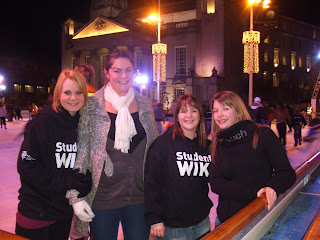
Leeds Met staff, students and associated friends recently enjoyed a night of both leisure and entertainment, as part of celebrations that marked the launch of the Leeds Met Student Wiki – a website which is based on the Wikipedia model and is geared towards the interests of both staff and students at Leeds Met. Entertainment Management students had previously helped by adding articles in the early days of the Wiki.

The Millennium Sqaure Ice Rink and Giant TV Screen (behind)


Celebrations were held in arguably Leeds most versatile leisure and entertainment facility – Millennium Square currently home to the UK’s largest outdoor ice rink. The square was built from the old Mandella Gardens and an adjacent car park as part of a £12m Millennium regeneration scheme. As an entertainment venue, Millennium Square has hosted numerous music concerts as well as showing live England fixtures on a fixed giant television screen. It is also home to the annual German Christmas Market and has recently held a natural history art installation. The Square’s rich entertainment nature is soon to be enhanced with the opening of the brand new Leeds City Museum which is right on the square.

The fairground that made up part of the 2006 German Market


For the launch of the Student Wiki, the main celebrations were in the form of ice skating, which for those participating in it is a leisure activity, but for those with two left feet (like me), provided a wonderful entertainment spectacle atching from the side lines. A selection of images from the night featuring Entertainment and Tourism Management students is below.

Wednesday, January 31, 2007

You Wouldn't Have Bet On it!

At odds of 16 to 1 who would have bet on Manchester being the next location for the UKs first resort casino? Certainly not some of the over confident people at Kerzner, one of whom told one of my colleagues only last week that the Greenwich bid was virtually a done deal. Blackpool also felt that their bid was the only one likely to win, ashen faced executives at Blackpool City Council yesterday were visibly shocked at Manchester becoming the chosen location – to many this was seen as Blackpool’s competition to lose – and lose it they did, to a better thought out, planned, structured and more realistic bid, that demonstrated a greater capacity for regeneration, and future prosperity from having a resort casino built.

Manchester is not a city that many people would consider to be a resort destination, neither is Greenwich – Blackpool is, but it is a resort that has suffered at the hands of many ‘get rich quick’ barons who care little about tacky signs on shops, external building maintenance, litter, and gangs of roaming stag and hen parties staggering along the town’s streets. Blackpool is partially a victim of its own success, it’s ‘kiss me quick’ image is now very out of date. The town has also reached a stage where too many of its clientele are gangs of young men in football shirts that are hell bent on a hedonistic weekend where the agenda may include a skin full of alcohol, abusive language, a kebab, possibly a fight, if they’re lucky an encounter with a lady - and if they’re not a vomit. There are plenty in Blackpool who would argue that this is only a small minority of visitors to the town, and there are some who are aware of this and have seen it happening for a long time, but would rather bury their heads in the Blackpool sand than do something about it. This type of image undoubtedly puts some people off of visiting the town, which has contributed to areas of urban decay and dereliction. Blackpool had a glorious past, and it is a shame that the town has faltered – but it is not alone, many other English seaside towns have suffered the same fate, and the behaviour of a particular segment of visitors to these towns is not the sole reason for their demise. Cheap and more accessible foreign holidays – often where the pound can stretch further, the rise of budget airlines, the unpredictability of the British climate, changing fashions, and globalisation (which contributes to a broadening of horizons) are all factors also. The best possible future for many of our seaside destinations will not be as huge resorts, but will be as smaller more humble towns that attract a more discerning clientele. This may mean down-sizing in some cases, but it is quality not quantity that could be the key to future success.

The Casino Advisory Panel (CAP) have not been convinced that a casino could regenerate Blackpool as a resort, and in fact they may just be right. A safer gamble to the regeneration of much of Britain’s seaside resorts is leisure rather than entertainment, and culture rather than glitz. Leisure undertakings are participative by visitors rather than passive, and entertainment is passive i.e. often where visitors are sat in an audience or being enthralled by somebody or something. The entertainment on offer at our seaside resorts, is perceived as out dated by many, and often does not attract enough people – particularly high spenders. But an increased societal emphasis on the benefits of physical activity means that leisure has a potentially bright future – albeit in the right places. There is scope at many seaside resorts to convert derelict and brown belt areas back to nature, with more parkland, conservation areas, and golf courses – which in turn may attract a greater proportion of higher spending visitors. In terms of culture, many of our seaside resorts have taken on a homogenous culture where one and all have become the same often tacky fish and chips by the sea experience. By taking a step back to the heritage and culture of a seaside town before mass tourism took place, it is possible to re-brand and market a destination based upon its background rather than just the fact that it is by the sea. This has been the case at Rothesay which now markets itself as a Victorian town to walkers, cyclists and sailing enthusiasts. Even Blackpool’s East Coast rival Scarborough promotes its ‘coastal walks, kids activities, parks, museums, galleries, landmarks, sport, outdoor activities and more’ (Thisisscarborough.org, 2007). Blackpool may be wise to concentrate its efforts less on its night-time entertainment, and more on it’s day-time leisure, heritage and culture.
Critics could argue that no seaside town should be the location of a regional casino as half of the potential catchment area is out at sea, meaning fewer people within the region. In fact the other seaside towns to be granted operating licences have received permission for only small (Scarborough) and large (Great Yarmouth) casinos. Perhaps Blackpool should have been less ambitious?

The case for Greenwich was unfortunately tainted by revelations in the media about John Prescott’s visit to the American ranch of Phil Anschutz, the developer of the Millennium Dome (now known as the O2) that was to be the site of the Greenwich casino. The Millennium Dome site has been dogged with controversy since its inception, it was thought by many that its transformation into a regional casino resort would prove pivotal in reviving its fortunes. It’s short term future now looks secure as little more than a venue for the 2012 Olympics. The allegations of corruption and sleaze that accompany such revelations would have made Greenwich simply the wrong choice to make. The Government simply could not afford to have chosen a location that the public would not support, as the building of Britain’s first regional super casino is already a contentious issue. There is currently no evidence to support whether or not a regional casino will lead to urban regeneration and an improved society anyway. Fear of increased gambling addiction, drug usage and prostitution make the building of these casinos highly contentious, so the choice for the winning bid needed to be one that would not meet with the general publics disapproval.

In Atlantic City on the East Coast of the USA, casinos were first built thirty years ago in a bid to improve the fortune of the city – they achieved this for a while, but drug usage, prostitution and urban decay is still rife. Many critics of the Atlantic City casinos argue that a proportion of casino clientele have exacerbated the city’s drug and prostitution problem. With that in mind the city of Manchester may also seem to be a strange choice of location, given the city’s already negative image in terms of gun, drug and gang culture.

The Manchester Bid is for an area of the town known as ‘Sportcity’ which is home to the largest ‘cluster’ of sporting facilities in the UK, which is a legacy of the Commonwealth Games that were held in Manchester in 2002. The area has already experienced some regeneration, with the construction of a large shopping centre, and the ‘B of the Bang’ sculpture. The Manchester bid was seemingly the best bid, and convinced the CAP that their bid would most effectively tackle deprivation and aid regeneration. The city already has three small scale casinos, the regional casino will dwarf these generating an estimated revenue of £100m per year. It is also estimated that it will create between two and three thousand jobs, with many local firms benefiting from the building of the casino as well as surrounding retail, entertainment, leisure and residential complexes. The societal impacts of this casino will not be known for a number of years, the smaller casinos will undoubtedly suffer, as will other local leisure and entertainment venues that will all be competing for a share of consumers’ disposable income. Whether crime and anti-social behaviour will increase is not known at this stage but this will be a test for other regional casino licenses being granted. If another regional casino license is granted in future years it is unlikely to be Blackpool that is chosen due to its close proximity to Manchester (approximately 50 miles), and the Greenwich site will most likely be taken over for Olympic usage until after the 2012 games, but it is likely that after the games it too could become a regional casino. My own bet for the UKs next regional casino is Glasgow – which missed out this time around, but will undoubtedly come back as a near front runner in the future. As for Blackpool the best it can now hope for is a ‘large’ casino license as was granted to several other British towns and cities including Great Yarmouth, Hull, Newham, Middlesbrough, Solihull, Milton Keynes, Leeds and Southampton.

Great Yarmouth which like Blackpool is a seaside town that has seen a decline in fortunes, has two possible locations, the town centre Marina, and an area of waste ground next to the Pleasure Beach. The town centre site would keep the casino at the heart of the resort, but the Pleasure Beach site may prove to be the most suitable due to its location away from the town centre, which would provide it with ample developmental room and parking.

As predicted in my blog entry last October, the former site of nightclub Majestyk in Leeds City Square will be the location of the Leeds large casino.

The de-regulation of the Gambling Act is set to transform the future of entertainment nationwide – only time will tell if this is to the benefit of society as well as to the bank balances of casino operators.

Wednesday, January 17, 2007

Thrillertainment

Thrillertainment is entertainment that is intended to thrill, excite, stimulate the senses – and sometimes cause fright. Thrill seekers enjoy the near-to-dangerous experiences which thrillertainment can give them. The experience of being thrilled causes sudden intense sensations including excitement and fright which can cause adrenalin to flow, and leave us in a variety of bodily states including being: in a heightened state of alert; ‘weak at the knees’; and having ‘butterflies in our tummies’.

These are all experiences that many (but not all) of us enjoy. Thrillertainment broadly appeals the most to younger people – particularly those in their mid to late teens and early twenties. This younger segment of the market are actively seeking out experiences that are new and exciting as a part of their growing and learning process.

Thrillertainment is a core product of, and the major attraction at theme parks, amusement parks, and fairgrounds where ‘scary’, ‘white knuckle’ rides entice those brave enough to try them out. Whilst the above best represents thrillertainment, this kind of entertainment can also be found more subtly on ‘ghost tours’, and ‘murder mystery weekends’. Some ghost tours such as the one held at Temple Newsam in Leeds feature actors playing ghosts and ghouls throughout the tour, that are designed to create atmosphere and instil a sense of fright amongst participants. Murder mystery weekends are designed to create atmosphere, intrigue, and trigger emotions in participants, which may be comparatively subtle thrills compared to those given by a rollercoaster, but none the less, they are still thrills, which puts them within the thrillertainment category within the entertainment industry.

Next week I will be experiencing thrillertainment first hand, when I visit one of the world’s greatest thrillertainment venues - Disney World in Florida, where I shall be visiting some Tourism students on work placement. A full report will appear on here thereafter.

Wednesday, January 10, 2007

Euro Sceptic?

Rarely are Eurovision Song Contest entrants self proclaimed celibate vegetarians who have been accused of flirting with fascist imagery. However the 2007 Great Britain (GB) entrant in the competition may just be this. If the media is to be believed, ex ‘The Smiths’ front-man Morrissey is currently in talks with the BBC with regards to negotiating a place in the competition. Of course to do this he would first have to win ‘A Song for Britain’ – which already established celebrities such as Blue’s Antony Costa and model Jordan have failed to do in the past against unknown opposition.

The Eurovision competition began in 1956 when the Swiss based European Broadcasting Union came up with the idea of each European nation submitting a singer to a competition that would be broadcast across European nations. At the time this was a groundbreaking project as satellite technology did not exist, and the European broadcasting network consisted of mainly microwave transmitters. However, televisions were far and few between so the largest audience were radio listeners. The GB, who through the BBC are now a major backer of the competition, did submit an entry for the 1956 competition, however the entry was late, and the entrant disqualified. The winning country was Switzerland, however the win for one (minor) hit wonder ‘Lys Assia’ was marred by a controversial voting system that allowed countries to vote for their own songs, and hosts Switzerland to vote on behalf of Luxembourg.

Since these humble beginnings the competition has risen to a global TV and internet audience that goes into hundreds of millions. The competition has predominantly produced winners that have gone on to do very little outside of their own countries, with of course exceptions such as Abba, Bucks Fizz and Brotherhood of Man. After a lull in the late eighties and early 1990s, the competition has seen a recent resurgence in popularity based upon a ‘cheese’ and ‘camp’ reputation. That said it still fails to attract high profile British acts – which is allegedly the reason for Morrissey’s interest.

Morrissey through his time with The Smiths was known for his strong anti-establishment views, and was once questioned by Police for claiming to have an executioner’s outfit to kill Margaret Thatcher, as well as producing songs such as ‘The Queen is Dead’ and ‘Shoplifters of the World Unite’. After leaving The Smiths, Morrissey’s solo career took off with a number one album ‘Viva Hate’, the singer still managed to court controversy though, when he was the support act to Madness at the first Madstock (1992) at Finsbury Park in London. Morrissey came on stage draped in a Union Jack with a photograph of a woman skinhead as his backdrop. The singer left the stage early due to persistent coin throwing at him from the audience. In more recent years Morrissey has made clear movements away from fascist association, by denying that he is racist and signing the Unite Against Fascism statement.

Having a man who once sang ‘Girlfriend in a Coma’ representing the GB in a competition associated with often bad, and camp music may seem slightly surreal, but that said, the singer can hardly do any worse than some of Great Britain’s more recent woeful entrants. Good luck Mozzer.

Monday, January 01, 2007

Techno Notice

Love it or loathe it, the internet is here to stay and is increasingly changing the way we work, relax, shop, communicate and generally live our lives. I have been an avid internet user since 1997, when I first discovered the joys of Netscape Navigator, the Yahoo search engine, and a UNIX based email system called PINE. The past decade has seen enormous advances in technology that has seen global internet usage grow beyond 1,000 million web users, with the focus no longer just being on information searching and email but a plethora of new web technologies (known as Web 2 technologies) including blogs, wikis, instant messengers (IMs) and the phenomenon of social networking.

In 2006 some of the most popular websites globally were: YouTube; MySpace; FaceBook; and Bebo. These type of sites allow users the opportunity to build their own web pages and add their own content including words, graphics, sounds, songs, and video clips. The success of these type of websites is down to a number of reasons, these include: simplicity of use - web sites becoming easier to use, with straightforward instructions for adding content; cost – it is quicker and much more cost effective to communicate and keep up to date via the internet (particularly the web and email / IMs) than via telephone or traditional mail; technological advancements - many people now have the ability to record their own sound and video clips from handheld devices such as mobile telephones; and a new generation of ICT literates - increased penetration of technology into the education curriculum means that younger people are becoming more competent with ICT.

Advancements in technology have signalled the death knell for a number of media formats, firstly vinyl and cassette tapes were almost made extinct by CDs, as was VHS to DVDs, but even these formats are now nearing the end of their shelf life with the media buying public increasingly turning towards the internet for legitimate or illegitimate music and video downloads. Gallup have finally cottoned on to this fact and as of 01/01/07 the UK music top 40 will now take into account all legitimate music downloads as well as shop-bought formats. Interestingly, this may mean that the Top 40 may in future include a number of oldies that suddenly become in demand as downloads – as well as B-sides. This will undoubtedly become apparent at the next major football tournament at which the England team play when ‘3 Lions’ will be in demand again.

Downloading media from the internet, isn’t just easy – because it can be done from the comfort of your own home, it is often cheaper than buying ‘hard copies’, and it can be much tidier than having to find even more shelf space for even more CDs. Mintel has predicted that in the future we will lead more minimalist lives with ‘losers’ in hard copy media sales. I can give a recent example of this from my own experiences. I own over 1,000 CDs – these are both albums and singles that spend 99.999% of their lives on shelves – unplayed. In fact I can’t actually remember the last time I sat down and listened to a CD – as I now much prefer being able to quickly and easily search the 16,000 MP3 tracks on my computers hard drive for the song I’m looking for and play it at CD quality through my stereo amplifier. Better still if I don’t know what I want to listen to, using either ‘iTunes’ or ‘Music Match Jukebox’ I have ‘the mother of all jukeboxes’ with over 30 days of continuous music to choose from – I can even carry my entire music collection around with me in my pocket courtesy of a 60Gb iPod which weighs little more than a mobile phone. This is the future, smaller, simpler, less clutter, and easier to find what you are looking for.

In terms of videos, I am currently in the process of ridding myself of over 200 bought VHS films which includes everything from ‘Romper Stomper’ to ‘Carry on Follow That Camel’. These take up some serious storage space – and I need that space back, but at the same time I don’t want to lose my films. The solution to this problem is called ‘eMule’ where I can easily download copies of the films that I already own (I’m not sure if that makes me a criminal or not) before packing the VHS tapes up into boxes and shipping them off to ‘Oxfam Books’ in Headingley, where they can be resold with the profits going to good causes. In fact Oxfam books has done very well out of my technological advances, as the majority of my CDs will also be heading their way, as I have now digitised all of them using a programme called ‘Audiograbber’. My Record collection (400 LPs, 200 12” singles, and 500 7” singles) will also be going the same way once I have turned all of my favourite tracks into MP3s courtesy of my Christmas present – an Ion USB Turntable – which using a programme called ‘Audacity’ can nicely and easily digitise records onto my computers hard drive (although this is going to take some time). Space wise I will eventually claim back an area the size of a double wardrobe – and replace it with a 500Gb hard drive which is about the size of two VHS tapes. Of course the risk in this (and there is always a risk) is that the hard drive goes kaput or is stolen and I lose everything – so just in case this does happen, I’m going to buy a second drive to back up my first drive, and then keep the second drive at my parents house…..just in case.

The only constant with technology is change, hopefully that means change for the better, which can have positive impacts upon us all – especially those amongst us who welcome it with open arms – and tidier shelves.